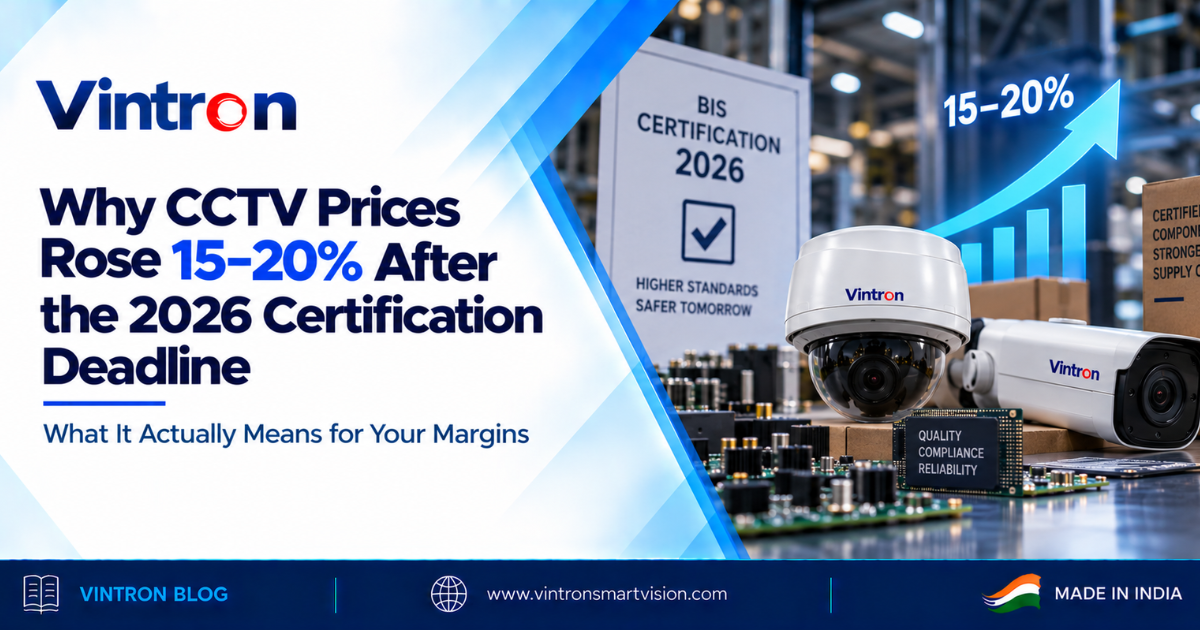
If you’ve noticed your supplier price lists creeping up over the past several months, you’re not imagining it, and it isn’t just one manufacturer padding margins. Multiple independent industry analyses, published across several months in 2026, converge on the same figure: CCTV production costs in India have risen by roughly 15 to 20 percent in the mid and high-end segments since the certification deadline took effect. This is an industry-wide shift, not a single company’s pricing decision, and understanding exactly why it happened tells you a lot about where to protect your margins going forward.
Where the Cost Increase Actually Comes From
The mechanism is straightforward once you see it laid out. Under the certification framework that took full effect on April 1, 2026, every manufacturer must declare the origin of critical components — specifically the System-on-Chip and firmware — and pass security testing at an accredited lab. Products built on Chinese-origin chipsets are, in practice, not getting certified.
That has forced manufacturers across the industry to redesign their component sourcing, shifting to alternative suppliers — largely Taiwanese chipset makers, with some sourcing from the US as well. New supplier relationships, smaller initial order volumes than the previous China-based supply chains enjoyed, and the engineering cost of requalifying a product against a new chipset all add up. Multiple analysts converge on the same 15-20% Bill of Materials increase for mid-to-high segment products as a result.
The Detail Most Coverage Misses: Entry-Level Pricing Has Stayed Comparatively Stable
This is the part worth paying attention to if you sell primarily in the value and mid-market segment, which is where most AHD-based systems compete. Several of the same reports documenting the 15-20% increase specifically note that entry-level pricing has remained comparatively stable, with the cost pressure concentrated in mid-range and high-end products — typically the higher-resolution IP and AI-analytics-heavy segments, where the component and certification burden is heaviest per unit.
If your business is built around dependable, value-focused AHD installations rather than premium IP deployments, this cost shift has likely hit your competitors’ higher-end product lines harder than it has hit the segment you actually sell into. That is a genuine, if quiet, competitive advantage worth knowing you have.
What This Means for Your Own Pricing Conversations
Three practical implications follow directly from this.
First, price increases from your suppliers right now are largely explainable by a real, documented industry shift — not opportunism. When a client pushes back on a quote that’s higher than what they paid two years ago, you have a legitimate, verifiable explanation rather than an awkward conversation about margin.
Second, this is exactly the moment to reinforce the total cost of ownership argument we’ve made before: a domestic manufacturer who requalified its supply chain in an orderly way over the two-year transition window is in a fundamentally more stable pricing position than one scrambling to source alternative components under deadline pressure. Ask your own supplier how far along their transition was before April 2026 — the honest answer tells you a lot about how stable your pricing will be over the next year.
Third, don’t assume every product category moved by the same 15-20%. Ask specifically, model by model, rather than applying a blanket assumption across your entire catalogue — the entry-level and mid-market products you likely sell most of may have moved considerably less than the headline figure suggests.
What to Actually Ask Before You Accept a Price Increase
Not every price increase your supplier passes on deserves to be accepted at face value, even when the broader industry trend is real. Ask specifically which component moved — was it the SoC, the firmware licensing, the PCB sourcing, or a combination? Ask whether the increase applies to the specific model you’re buying or is a blanket adjustment across the whole catalogue. A manufacturer who can answer these questions with specifics is telling you something different than one who simply says "costs went up industry-wide" and leaves it there.
This is also worth asking about your manufacturer’s own component sourcing timeline. A supplier who began requalifying components in 2024, well ahead of the deadline, absorbed the transition cost gradually over two years. One who waited until early 2026 to start is likely still working through a more volatile, rushed sourcing process — and that volatility tends to show up as unpredictable price swings on your own price list for longer than it should.
Passing the Increase Through Without Losing the Client
When you do need to pass a price increase to a client, the framing matters enormously. Leading with "prices went up" invites negotiation on the number. Leading with the actual reason — a documented, industry-wide certification and component sourcing shift that affects every compliant manufacturer, not just yours — invites a completely different conversation, because it’s verifiable and the client likely has already seen it referenced elsewhere.
Pair that explanation with a reminder of what they’re actually paying for now versus two years ago: verified component origin, security-tested firmware, and a certification trail that protects them from exactly the kind of scrutiny discussed in our piece on what happens to old imported systems. The price increase becomes evidence of a system built to last, not just a number that went up.
The Certification Cost Won’t Stay a One-Time Event
It’s worth setting expectations correctly here: this isn’t a single price adjustment that settles once and stays flat. Certification is model-specific, and manufacturers are continuing to work through their ranges well into 2026 and beyond, with new models requiring their own testing and certification cycle before launch. Component pricing for Taiwanese and other alternative chipset suppliers is also still stabilising, as demand from the entire Indian CCTV industry shifted toward the same handful of suppliers more or less simultaneously — that kind of concentrated demand shock doesn’t always resolve smoothly or quickly.
The practical takeaway for dealers: build a habit of checking in with your manufacturer on pricing quarterly rather than assuming last year’s price list holds indefinitely, and favour manufacturers who communicate pricing changes proactively over ones who let you find out from an updated invoice.
This is also a good moment to revisit your own quoting templates. If your standard proposal format doesn’t currently break out certification and compliance as a distinct line item, add it — it gives you a natural place to explain the cost shift without it looking like a hidden markup buried inside the hardware price.
The Bottom Line
The cost increase is real, well documented across independent sources, and industry-wide — not a reason to distrust your supplier’s new price list. What matters now is understanding exactly where the pressure is concentrated (mid-to-high end, IP and analytics-heavy products) versus where it’s milder (entry-level, value-focused systems), and pricing your own quotes with that nuance rather than a flat markup adjustment. We manufacture across the AHD and power supply range in India, and we’re glad to walk through exactly how our own pricing has moved, model by model, if it helps you plan your next quarter.