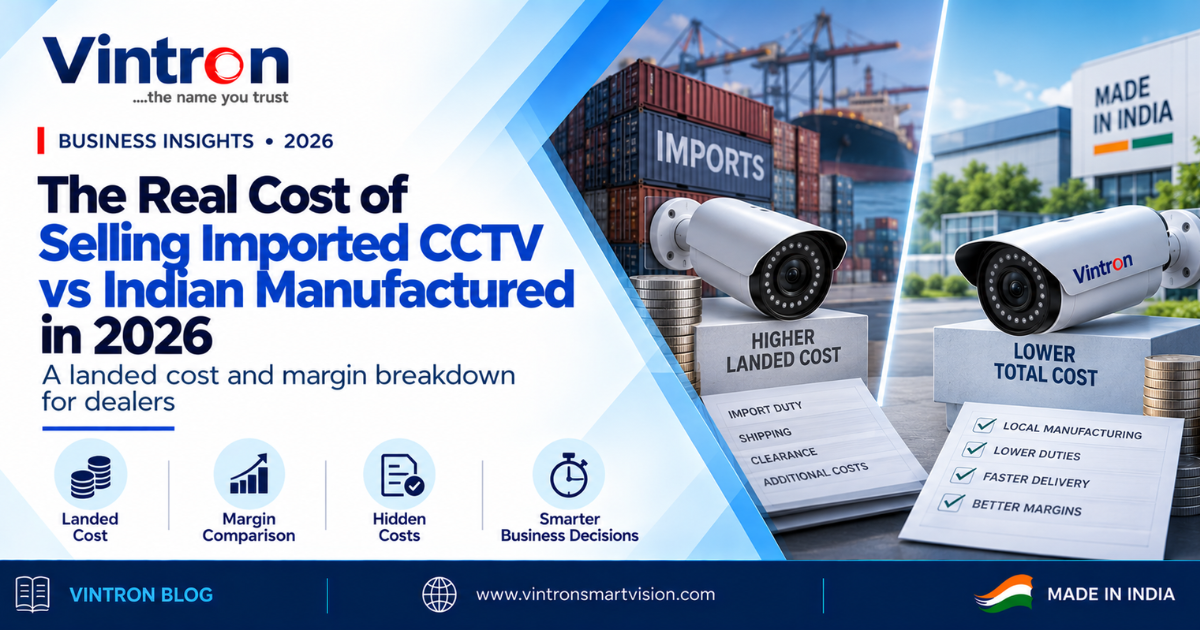
Every dealer in this trade has met him. The guy at the counter next door who leans over and says: "Why are you buying Indian, bhai? I get the same camera imported for ₹1,100. You’re paying ₹1,400. You’re losing ₹300 on every piece."
He sounds convincing, and he has an invoice to prove it. What he doesn't have is the rest of his own accounting. That ₹1,100 is the first line of a cost, and by the time the full stack gets added — duties, freight, frozen capital, self-insured warranty, unsold stock — his “cheaper” camera is often the most expensive item in his shop. He just doesn't know it, because nobody ever sat him down with the math.
So let's do the math. We've been manufacturing security products in Delhi since 1991, and we've watched this exact calculation decide which dealers grow and which ones quietly exit the trade.
Part 1: The Landed-Cost Stack (What the Invoice Doesn’t Show)
Start with that imported camera at ₹1,100 on the invoice. One honest note: duty structures shift with every budget, so treat these as illustrating the shape of the stack, and verify current rates before modelling your own business.
Freight, insurance and handling come first, adding several percent before the box touches Indian soil. Then customs duty — kept firm to push local manufacturing, plus a surcharge on top. IGST on import is the sneaky one: you eventually claim it as input credit, but at import time it's cash out of your pocket, parked with the government for weeks or months. Then clearing agent fees, documentation, transport — small individually, never zero.
And finally the 2026 addition: every camera model sold in India now needs certification, and imported models must clear the same testing per model, paid upfront, before a single unit can legally sell. Skip it, and the inventory isn't cheap — it's contraband, seizable at customs or on the shelf.
Stack it all up and the dealer-next-door's ₹1,100 camera has typically landed around ₹1,500–1,600 before margin — before we've counted a single hidden cost. Those decide his fate.
Part 2: The Hidden Stack (Where Import Businesses Actually Die)
Frozen capital. Importing means minimum order quantities — often ₹8–15 lakh at a time, committed months in advance, floating on a ship, then sitting in a godown while it sells through. The dealer buying Indian-manufactured stock orders what he needs and restocks in days.
Here's the single most important calculation in this post. Take two dealers, each with ₹10 lakh of working capital. Dealer A imports: a fat-looking 20% margin, but his capital completes a full cycle maybe 3 times a year. Annual gross: 10,00,000 × 20% × 3 = ₹6 lakh. Dealer B buys Indian-manufactured: a “smaller” 13% margin, but with no ocean and no containers, his capital rotates 8 times a year. Annual gross: 10,00,000 × 13% × 8 = ₹10.4 lakh. Same shop, same money — the lower-margin dealer earns nearly twice as much. Distribution profit is rotation, not margin.
Currency risk sits on every import order until it's paid for, and the importer carries it forever. Warranty self-insurance is worse: when an imported unit fails, there's no factory to send it to, so the importer either eats the loss or loses the customer — effectively running an unlicensed insurance company. The dealer selling Indian-manufactured products sends the unit back under a 2-year manufacturer warranty to a factory in Okhla, and the cost sits where it belongs.
Dead stock is the next gamble — import in bulk and you're betting on what the market wants months from now. Buying domestic in small, frequent lots shrinks that to a rounding error. And the doors that stay closed: the importer can't touch government and institutional business, the largest, steadiest buyer segment, now reserved for certified made-in-India equipment.
Part 3: The Indian-Manufactured Side of the Ledger
You buy in rupees at transparent dealer pricing. GST flows through the normal input-credit cycle, with no lakhs parked at a port. Stock arrives within days, so you carry weeks of inventory instead of months. Certification — BIS, CE, FCC — is the manufacturer's job, done before the product reaches you. Warranty failures travel back to the maker instead of into your pocket. And your shelf carries the complete ecosystem from one source — cameras, DVRs, NVRs, power supplies, and PoE switches across our Premium and Ultra series — which lifts your invoice value without lifting your risk. Is the per-unit price sometimes higher than a Shenzhen catalogue's? Sometimes, yes. It's the price of a business that's still standing in five years.
Part 4: Do This Tonight — Your Own Ten-Minute Audit
Take your last import-sourced purchase and build its true landed cost: invoice, freight, duty, surcharge, the IGST cash-flow hold, clearing, transport, compliance. Count your capital rotations: annual purchases divided by average working capital. Under 4, and you now know why the year felt harder than the margin suggested. Add up twelve months of warranty losses you absorbed silently. Then put the two models side by side — annual profit against annual profit. The spreadsheet will make the decision long before any brochure does.
The Bottom Line
The dealer next door isn't lying about his ₹1,100 invoice. He's reading one line of a ten-line story, and the other nine are written in his own money. If you'd like to run that arithmetic on your own business, with real dealer pricing and your actual product mix, we'll sit down and do it with you. We've been on the Indian side of this equation since 1991.