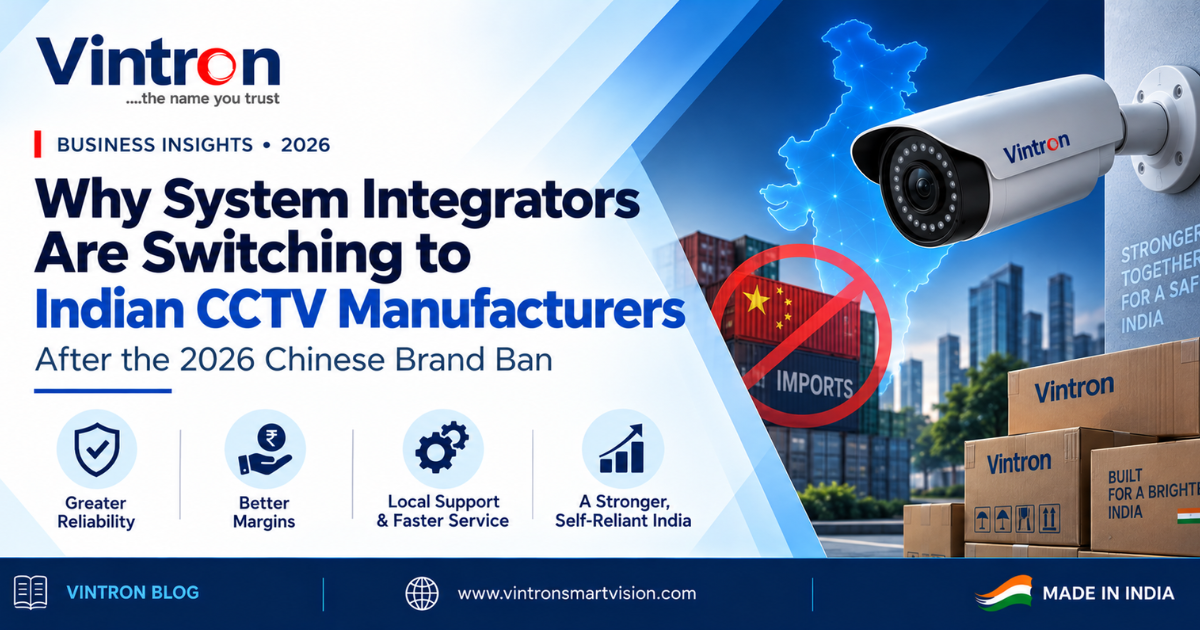
If you're a system integrator in India, April 1, 2026 probably didn't feel like just another compliance deadline. It felt like the ground shifting under your feet.
One day, the brands that made up a huge chunk of your project quotes — Hikvision, Dahua and other Chinese names — were the default choice. The next day, most of their internet-connected cameras couldn't legally be sold, imported, or installed in India. Just like that.
We've been manufacturing security products in Delhi since 1991, and in three decades we've never seen the market turn this fast. So let's talk about what actually happened, what it means for your business, and why so many integrators are quietly making the switch to Indian manufacturers — many of them for good.
Here's the short version, without the legal jargon.
Back in April 2024, MeitY (the Ministry of Electronics and IT) issued Essential Requirements for CCTV cameras and gave the industry a transition window to comply. Every internet-connected camera sold in India now has to be certified under the government's STQC regime — which means declaring where critical components like the System-on-Chip and firmware come from, and passing vulnerability testing at accredited labs to prove the camera can't be accessed remotely by people who shouldn't be accessing it.
That transition window closed on April 1, 2026. Products made in China, or built on Chinese chipsets, are simply not getting certified. The result: the biggest Chinese surveillance brands are effectively out of the Indian market.
And if you're wondering why the government moved so decisively — the espionage case uncovered in Ghaziabad in March 2026, where unsecured camera feeds were being exploited and footage was flowing across the border in real time, removed whatever doubt was left. This isn't a trade tantrum. It's a national security decision, and it's not getting reversed.
Now let's talk about your side of this, because the news coverage focuses on the brands — but it's integrators who feel the pain first.
Your existing installations just became orphans. Every Chinese-brand system you've installed over the years still works today. But spare parts, replacement units, firmware support, RMA — all of that is drying up. When a client's NVR fails next year, what exactly are you going to replace it with?
Uncertified stock is a liability, not an asset. There's discounted Chinese inventory floating around the market right now, and it's tempting. Don't. You can't legally support it, you can't get it replaced under warranty, and if a government or corporate client audits their installation — and audits are happening across the country right now — your name is on that invoice.
Clients are asking questions they never asked before. “Is this camera STQC certified?” was not a sentence anyone said in 2024. Today, procurement teams, housing societies, and even individual shop owners are asking for certificates. The integrator who can answer confidently wins the job. The one who can’t, doesn’t.
Your quotes are stuck in limbo. Projects quoted on Chinese brands before April are being re-quoted, re-approved, and re-budgeted. Every week of delay is money you're not making.
Sound familiar? You’re not alone. This is exactly why the switch to Indian manufacturers has gone from “nice idea” to “business survival” in a matter of months.
Here's the thing most integrators discover once they make the switch: partnering with an Indian manufacturer isn't a compromise you settle for. In several ways, it's simply a better way to run your business. Let us walk you through why.
1. Compliance is built in, not bolted on. When your supplier manufactures in India — the way we do at our facility in Okhla, New Delhi, with ten fully automatic SMT lines producing boards in-house — certification is the manufacturer’s job, handled at the factory level. Our products carry BIS, CE, and FCC certifications, and when norms evolve (and they will keep evolving), we adapt on the production line. You just keep installing. No more checking every model number against a government list before you dare to quote it.
2. The tender market just opened up for you. Government departments, PSUs, banks, schools, smart city projects — this is the biggest, most reliable segment in Indian surveillance, and it now belongs almost entirely to made-in-India, certified equipment. If a chunk of your revenue used to come from private projects because you couldn't touch tenders with foreign-origin products, that wall just came down. Integrators carrying an Indian brand can bid where importer-dependent competitors simply can't.
3. Support that’s in your time zone — and your language. When a DVR misbehaves on-site at 4 PM on a Saturday, you don’t need a ticket number from a server farm overseas. You need a phone that gets picked up. Our dealers and integrators call our toll-free technical support line (1800-121-4322) and talk to engineers sitting in the same country, backed by a factory that can actually repair and replace. Every Vintron product carries a 2-year warranty — and it’s a warranty with an address, not a promise with a shipping problem.
4. One brand, one ecosystem, one throat to choke. The best integrators standardise. Mixing brands means mixing apps, warranties, firmware quirks, and support numbers — and your technicians pay for it on every service call. An Indian manufacturer with a complete range lets you build the entire project from one catalogue:
One support number. Your service calls get shorter and your margins get cleaner.
5. Stock when you need it, in quantities that make sense. No containers, no 45-day lead times, no lakhs of rupees frozen on a ship. You order in INR, in project-sized quantities, and restock in days. In a market that's repricing itself month by month, that flexibility is worth more than any discount an importer can offer.
Fair question — and yes, the market has seen some price movement since the ban, especially in mid and premium segments, because certification and secure components cost money.
But look at what you're actually buying now: a camera that's been vulnerability-tested at an accredited lab, with a declared supply chain, a real warranty, and a manufacturer you can visit by taking a metro to Okhla. Compare that with the old model — cheap hardware, mystery firmware, and a warranty that ended at the port.
Your clients aren't just paying for a camera anymore. They're paying for the assurance that their own security system isn't a security risk. After Ghaziabad, that's not a hard conversation to have. In fact, it's the easiest upsell this industry has ever been handed.
If you're ready to move, here's what we'd suggest — and it's the same advice we give every integrator who calls us:
Start by auditing your existing client base. Every Chinese-brand installation out there is a replacement opportunity over the next 12–18 months as parts dry up. Reach out to those clients before their system fails — you'll look proactive, and you'll own the upgrade.
Then standardise your new projects on one certified Indian ecosystem. Get trained on it, stock the fast movers, and put the certification documents in your proposal template. The integrators winning right now are the ones who turned compliance into a selling point instead of a headache.
And pick a manufacturing partner with history. Anyone can print a brochure in a boom market. A factory that's been running since 1991, with 200+ engineers and a 30-year-old PAN-India channel network, has survived every disruption this industry has thrown at it — and this one is no different.
The 2026 ban didn't create a crisis for system integrators. It ended one — the slow-motion crisis of building businesses on products with no local accountability, no real warranty, and, as it turned out, no future in this market.
Indian manufacturers now supply the overwhelming majority of this market, and that share was earned the moment integrators realised what they'd been missing: a partner in the same country, on the same phone network, standing behind every box.
If you’re an integrator rethinking your brand partnerships, let’s talk. Explore our complete product catalogue, read our story, or just pick up the phone.