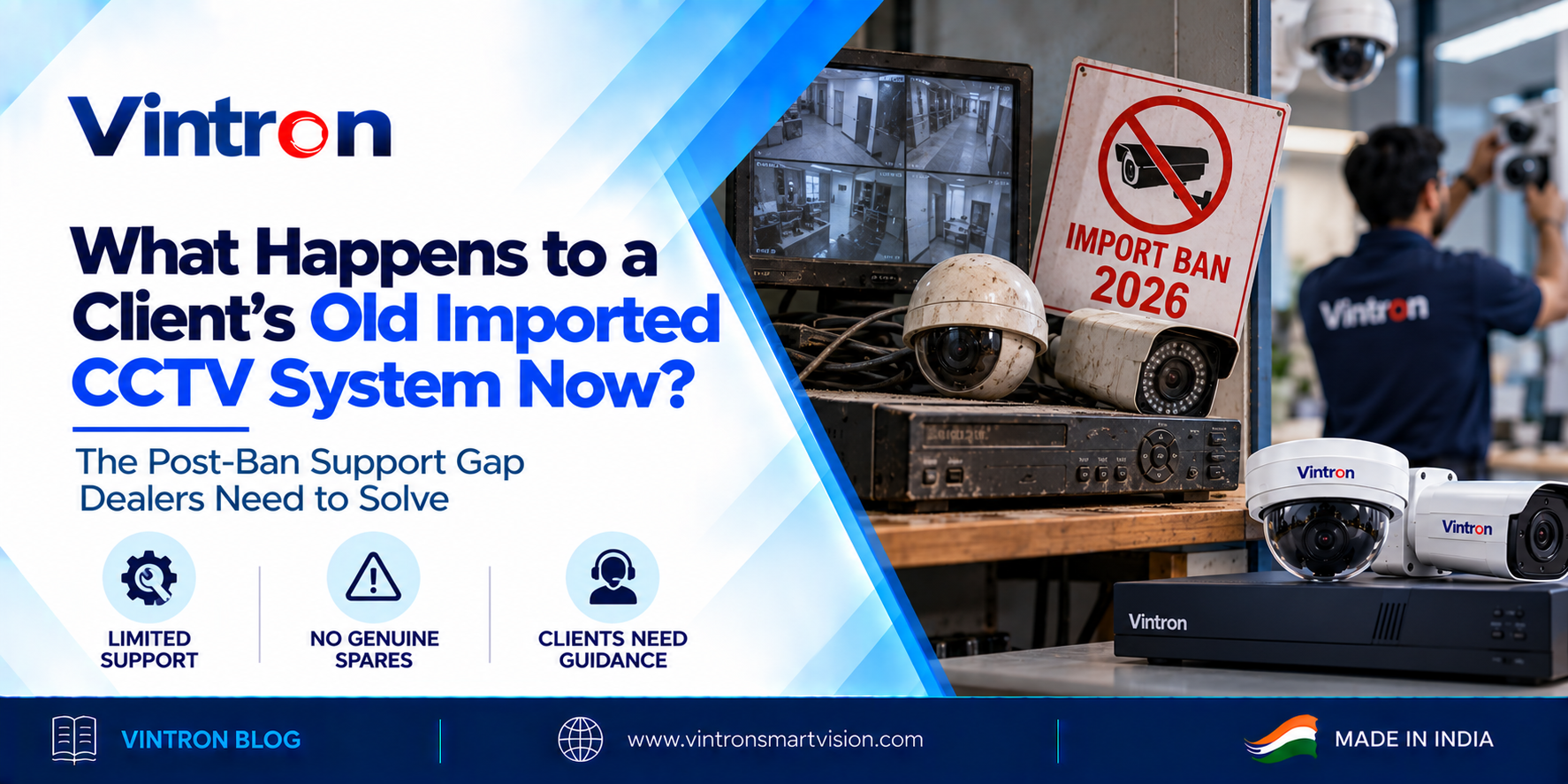
Here’s a conversation happening in dealer offices across India right now, whether they’ve had it out loud yet or not: a client with a working, several-year-old imported CCTV system calls in with a routine service request, and the dealer realises there’s no straightforward answer anymore for how to support it. The system still works. Getting it properly maintained, updated or expanded is a different question entirely — and that gap is a real, documented consequence of the 2026 certification rules, not a hypothetical risk.
What Actually Changed for Already-Installed Systems
To be precise about what the rules actually say, since a lot of confused coverage exists on this point: nothing requires anyone to remove or stop using an existing camera system. The certification framework restricts new sales of non-compliant internet-connected cameras — it does not touch what’s already installed and working. A client’s existing system remains perfectly legal to keep using.
What changes is everything around continued support. As affected manufacturers scale back or exit the Indian market, official firmware updates, security patches, app functionality and cloud services for their existing installed base become, in the words of multiple independent reports, "irregular" or may "stop entirely." An internet-connected camera that stops receiving security patches becomes a growing risk over time — not because it suddenly breaks, but because known vulnerabilities never get fixed while the camera keeps running, connected, indefinitely.
Three Specific Problems This Creates for Your Clients
The first is straightforward expansion. A client who wants to add a few cameras to an existing affected-brand system can no longer simply extend it — the new units they’d need aren’t legally sellable, and compatible components are increasingly difficult to source at all as manufacturers scale back their Indian operations.
The second is security exposure, which compounds quietly. Documented, publicly disclosed vulnerabilities in some affected brands’ equipment already exist. Without ongoing patches, that exposure doesn’t improve — it only grows the longer the system stays in service unpatched, particularly for any client on a network with sensitive data.
The third is institutional pressure, which is accelerating faster than many dealers expect. Following the well-publicised espionage case involving compromised camera feeds earlier in 2026, multiple reports describe a broader pan-India push toward auditing existing CCTV installations, particularly in government-linked and security-sensitive sites. A client whose installation gets flagged in an audit doesn’t have the luxury of a leisurely replacement timeline — and the dealer who can respond fastest keeps that relationship.
This Is a Genuine Business Opportunity, Not Just a Warning
The dealers treating this proactively are turning it into one of the more reliable revenue conversations available right now. Rather than waiting for a client’s system to fail or get flagged, reach out to your existing client base specifically about systems installed with brands that are now restricted, and offer an honest assessment: what still works fine, what’s genuinely at growing risk, and what a phased, budget-friendly upgrade path looks like using certified equipment.
This pairs directly with the preventive maintenance relationship we’ve written about before — a routine AMC visit is the natural moment to have this conversation, model number in hand, rather than a cold outreach that can feel like a sales pitch. Framed as protecting the client rather than selling them something new, it lands very differently.
When you do move a client toward replacement, this is also the moment to make certification and documentation part of the pitch itself — verifiable certifications aren’t an abstract compliance detail anymore. They’re the specific, concrete answer to "will I be back in this same position again in two years."
Building a Simple Audit Process for Your Own Client Base
Most dealers don’t have a clean record of exactly which brand and model sits at each client site, especially for installations done several years ago. Before you can have any of these conversations proactively, you need that list. Start with your highest-value commercial and institutional clients — the ones most likely to face an actual audit or compliance question — and work outward from there. A simple spreadsheet noting client, install date, brand and model is enough to start; it doesn’t need to be sophisticated to be useful.
Once you have that list, prioritise outreach by risk rather than by convenience. A government-linked or financial-sector client running an affected brand is a very different urgency level than a small retail client running the same equipment — not because the small client doesn’t matter, but because the institutional client is far more likely to face an audit request on a timeline you don’t control.
What a Realistic Replacement Conversation Sounds Like
The dealers who handle this well don’t lead with "you need to replace everything immediately" — that’s both inaccurate and a hard sell that damages trust. A more honest and, frankly, more effective framing acknowledges that the existing system still records and still works, walks through the specific risks (no more firmware patches, no easy expansion path, growing exposure over time), and proposes a phased plan: perhaps starting with the highest-risk cameras — those covering entry points or sensitive areas — while leaving lower-priority cameras on the existing system until a natural replacement cycle.
This phased approach also solves a real budget objection. Very few clients want to write off a fully functional system all at once. A phased plan, backed by a genuine explanation of relative risk, gets you into the account without asking for a decision the client isn’t ready to make.
Document Everything You Recommend, Even What the Client Declines
When a client chooses to delay replacement or only act on part of your recommendation, put that decision in writing — a simple written summary of what you assessed, what you recommended, and what the client chose to proceed with. This isn’t about covering yourself defensively so much as it’s good practice: if that client’s installation does get flagged in an audit or suffers an incident down the line, having a documented trail of your professional recommendation is valuable for both of you, and it reinforces exactly the kind of proactive, trustworthy positioning that turns a one-time replacement job into a long-term client relationship.
None of this needs to feel like extra paperwork bolted onto your existing process. A one-page assessment template, reused across every client, takes minutes to fill in during a site visit and pays for itself the first time it protects a client relationship during an awkward moment.
The Bottom Line
Nobody is forcing your clients to rip out working equipment. What’s genuinely changed is the support, expansion and security picture behind systems built on brands now restricted from new sales in India — and that gap is exactly the kind of problem a proactive dealer can solve before it becomes the client’s emergency. We’ve manufactured DVRs and AHD cameras in India since 1991, with a support line that isn’t going anywhere — talk to us about a phased upgrade path for any client you’re currently worried about.