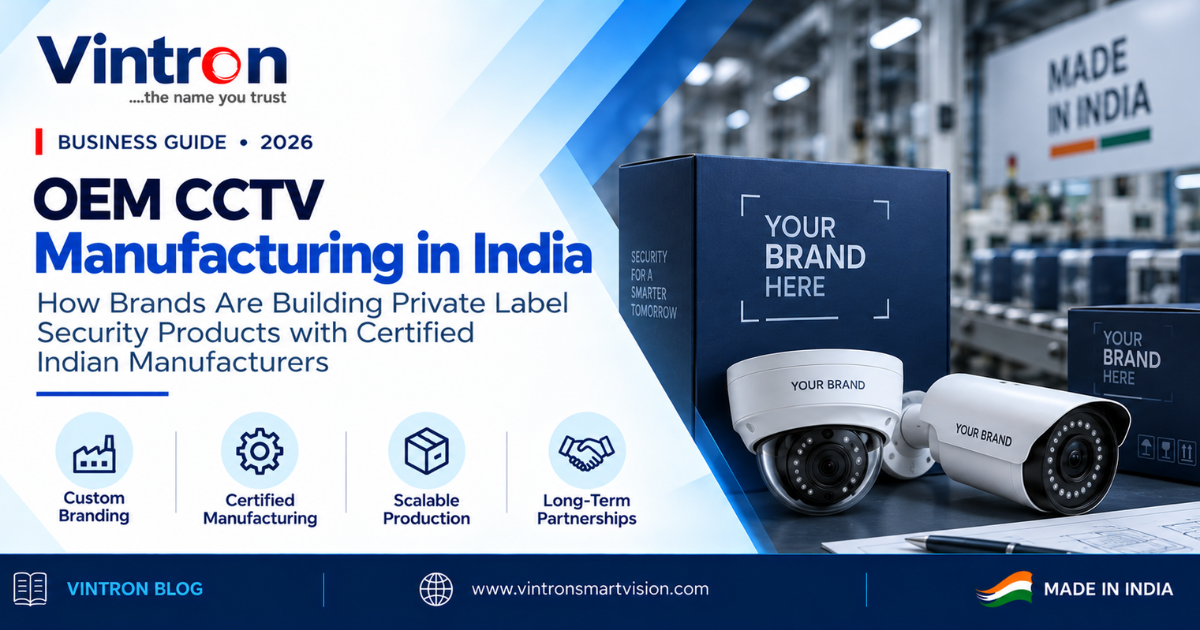
There’s a phone call we’ve been getting a lot lately at our Okhla factory, and it usually starts the same way: "We’ve been selling CCTV under our own brand for years. Our supplier was in Shenzhen. You know what happened. Can you build our products here?"
Sometimes it's a distributor with a strong regional brand that suddenly has no factory behind it. Sometimes it's an electronics company that always wanted a surveillance line but never wanted a surveillance factory. Different stories, same destination: private-label CCTV, manufactured in India, with certifications that hold up.
We've been manufacturing electronics in Delhi since 1991, for our own brand and for others, so let us walk you through how OEM CCTV manufacturing in India actually works, what changed after the ban, and how to choose a manufacturing partner you won't regret.
Why the OEM Boom Is Happening Right Now
For fifteen years, building a CCTV brand in India followed a simple recipe: fly to China, pick products from a catalogue, put your logo on them, ship containers. The "brand" was a sticker with a marketing budget behind it.
That recipe has been dying in stages. First came BIS registration, then MeitY's Essential Requirements demanding cybersecurity testing and disclosure of where critical components like the SoC and firmware come from. Then April 2026 arrived, the transition windows closed, and non-compliant cameras — most of what the sticker-brands were importing — could no longer be sold. Government procurement had already gone further, giving hard preference to genuinely local manufacturing under Make in India rules.
Indian manufacturers now supply the large majority of CCTV sold in this country. Building a factory means SMT lines, component supply chains, test labs, and years. Partnering with one means your brand keeps its identity and momentum while a certified Indian facility handles everything behind the logo. That's OEM manufacturing, and it's why our phone keeps ringing.
OEM, ODM, EMS: The Jargon, Translated
EMS (Electronics Manufacturing Services) is contract manufacturing at the board level — you bring a design, the factory builds it: SMT assembly, pick-and-place, reflow soldering, functional testing. This is the foundation, and where you should judge any factory first, because board quality is product quality.
OEM (Original Equipment Manufacturing) is what most brands actually ask for: products built to an agreed spec, sold under your name. Your logo, your carton, your channel; our lines and testing.
ODM (Original Design Manufacturing) goes further — the factory's own proven designs, adapted and branded for you. It's the fastest route to market because the engineering and compliance groundwork already exist. Most successful private-label programmes in India today blend the two: start ODM to reach market quickly, then customise deeper as volumes grow.
What to Look For in an OEM Partner: The Hard Questions
What the Journey Actually Looks Like
It starts with a conversation about your market rather than circuit boards: what your channel sells, at what price points, against whom. Then product selection, sampling — test units hard in your own conditions and push back on anything that isn't right, far cheaper now than later. Compliance work runs in parallel: testing, documentation, registrations. Then branding — logo, housing, cartons, your identity inside the viewing software your customers open daily. Then production, full testing, and dispatch — from Okhla, not a port on the other side of an ocean. And then the part that separates a supplier from a partner: it keeps going. Firmware support, repairs, and a factory your people can call on 1800-121-4322 — or visit by taking the Delhi metro instead of a flight with a visa.
The Economics, Honestly
Is private-label manufacturing in India cheaper than the old Shenzhen catalogue game at its peak? Unit for unit, not always. What it is, is viable — which importing no longer is. No customs duty and freight stack, no currency roulette, no lakhs frozen in containers, no compliance risk that can strand your inventory overnight. Add what the new rules hand a genuinely made-in-India product: access to government procurement that import-origin brands are locked out of, and a Made in India line buyers now actively look for.
The Bottom Line
The Chinese ban didn't kill private-label CCTV in India. It killed the lazy version of it. If you're rebuilding a brand that lost its factory, or building one for the first time, come see what three decades of Indian electronics manufacturing looks like. Walk our Okhla facility, meet the engineers, and judge the answers for yourself.