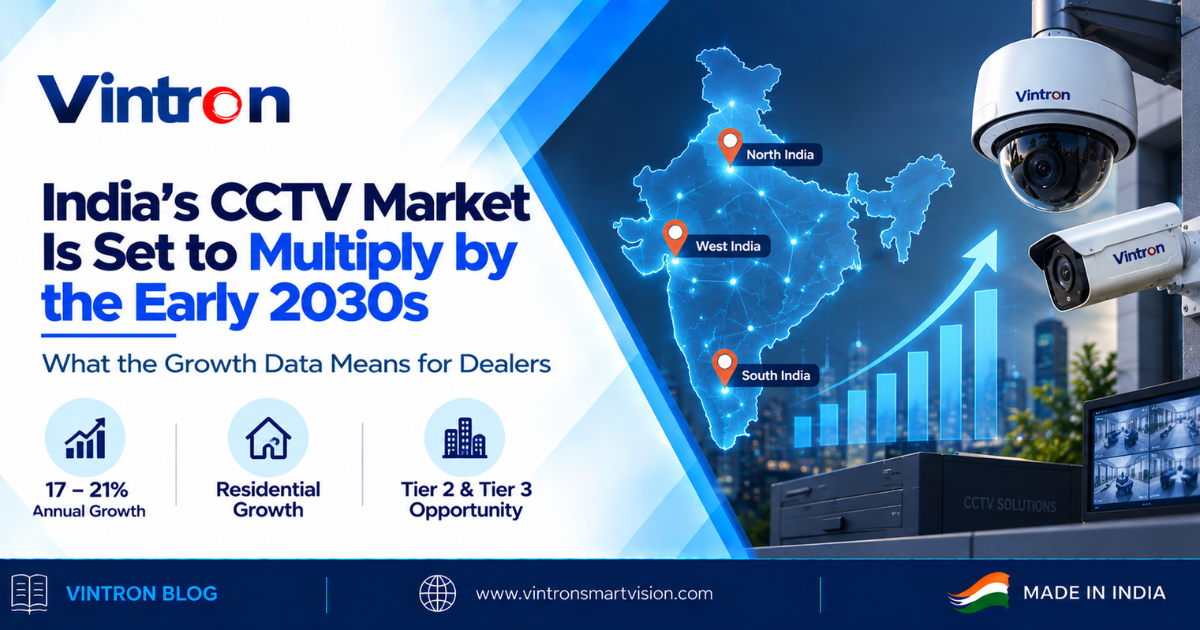
Ask ten different research firms how big India’s CCTV market actually is, and you’ll get ten different numbers. Depending on which report you read, the current market sits anywhere from roughly $2.4 billion to $5.75 billion, headed toward figures as varied as $8 billion, $14 billion or $24 billion by the early-to-mid 2030s. Different firms measure different things — some count hardware only, some fold in software and services, some define "surveillance" more broadly than others.
Strip away the disagreement on the exact number, and every single one of these reports agrees on the same underlying story: India’s CCTV market is growing at somewhere between 17% and 21% a year, compounding, for most of the next decade. That is an extraordinary growth rate for a market this size, and it changes how dealers should be thinking about their own business right now — not just about total demand, but about where that demand is actually concentrating.
The Regional Picture Is Where the Real Signal Is
Total market size numbers are useful for headlines. Regional breakdowns are useful for actually deciding where to focus. Here, the research is far more consistent across firms.
North India holds the largest share of the market — estimates range from roughly 32% to 42% depending on the source — driven by Delhi-NCR, Uttar Pradesh and Haryana, with heavy government and safe-city spending, ANPR-enabled traffic cameras, and a dense concentration of both central and state institutions. This region is expected to hold its lead through the early 2030s as safe-city and intelligent transport programmes continue to expand.
West India — Maharashtra and Gujarat specifically — holds around 27% share and is growing at roughly 18-19% CAGR, driven by Mumbai and Pune commercial real estate, plus Gujarat’s ports and industrial estates. This is a genuinely different buyer profile from North India’s government-heavy demand: West India’s growth is coming from warehouses, manufacturing plants and logistics corridors, which is exactly the vertical we’ve written about separately for dealers pitching warehouses and factories.
South India is the fastest-growing region on a percentage basis across nearly every report we reviewed, with CAGR estimates around 19-20% through the early 2030s, building on an already strong existing installed base. If you’re a dealer deciding where to expand a second territory or open a new branch, South India’s growth rate alone makes it worth a serious look.
Government Still Leads, But Residential Is Catching Up Fast
By end-user vertical, government remains the single largest buyer — one widely cited estimate puts government at around 38% of 2025 revenue — which lines up with everything we’ve written about the tender opportunity for dealers willing to navigate GeM registration and compliance requirements.
The more interesting number for most dealers reading this is the growth rate in residential and smart-home deployments, estimated at around 20% CAGR — among the fastest-growing end-user categories in the entire market. This is not a niche segment anymore. A dealer who has been treating residential CCTV as a low-priority, low-margin add-on to commercial work is leaving one of the fastest-growing parts of the market almost entirely unaddressed.
Analog Still Has a Real Place in This Growth Story
Here is where the research genuinely disagrees, and it’s worth being upfront about it rather than picking whichever number suits us. One widely cited report puts analog camera share at just over half the market in 2025. Another equally credible report puts IP camera share (excluding PTZ) at nearly 60% for the same year. These cannot both be describing the same market the same way — the difference almost certainly comes down to how each firm defines and counts hybrid and HD-analog systems within their "analog" versus "IP" categories.
What we can say with confidence, because every report agrees on this part: analog and HD-analog systems remain the backbone of cost-sensitive deployments and Tier 2 and Tier 3 city rollouts, where budget discipline and simple, reliable infrastructure matter more than the ceiling of what a top-end IP system can theoretically do. Wired connectivity as a whole still commands roughly two-thirds of the market by one estimate, even as wireless grows faster in percentage terms from a smaller base. For dealers building a business around AHD systems, that is a reassuring signal, not a warning sign — the category is not shrinking, even as the AI-enabled and wireless segments grow quickly around it.
What This Means for How You Plan the Next 12 Months
Tier 2 and Tier 3 Cities Are Where Most of This Growth Actually Lands
One detail that shows up consistently across the research, even amid disagreement on exact market size: CCTV penetration remains heavily concentrated in Tier 1 and Tier 2 cities today, which several reports put at well over 80% of current demand. That sounds like a statement about where the market already is — but read the other way, it’s a statement about how much headroom exists in Tier 3 towns and smaller district headquarters that haven’t seen meaningful CCTV penetration yet.
This is exactly the segment where a dealer’s cost structure and manufacturer relationship matter more than brand recognition. A Tier 3 market doesn’t reward the flashiest AI-analytics pitch — it rewards the dealer who can install reliably, price sensibly, and service the system without a multi-day round trip for every support call. That is, structurally, where AHD systems and straightforward DVR-based recording continue to win on merit, not just on price.
Why the Growth Rate Itself Matters More Than the Headline Number
It’s worth pausing on what a sustained 17-21% CAGR actually compounds to. At even the more conservative end of that range, a market roughly doubles every four years. At the higher end, it can double in under three and a half. Whichever specific dollar figure you trust from the competing reports, the compounding effect is the same: a dealer who is merely holding market share flat over the next three years is, in relative terms, falling behind a market that’s growing this fast around them. Standing still is not actually standing still — it’s losing ground.
That reframes a lot of ordinary business decisions. Adding a second technician, opening a small branch office in a neighbouring district, or simply investing more seriously in a preventive maintenance offering to retain the client base you already have — all of these look considerably more urgent against a backdrop of near-20% annual market growth than they would in a flat or slow-growing market.
The Bottom Line
The exact size of India’s CCTV market depends on who you ask. The direction does not — this is a market growing at close to 20% a year for most of the next decade, with clear regional and vertical patterns that any dealer can act on today. We’ve been manufacturing AHD cameras, DVRs and networking equipment in India since 1991, and we’re happy to talk through what this growth looks like specifically in your territory.