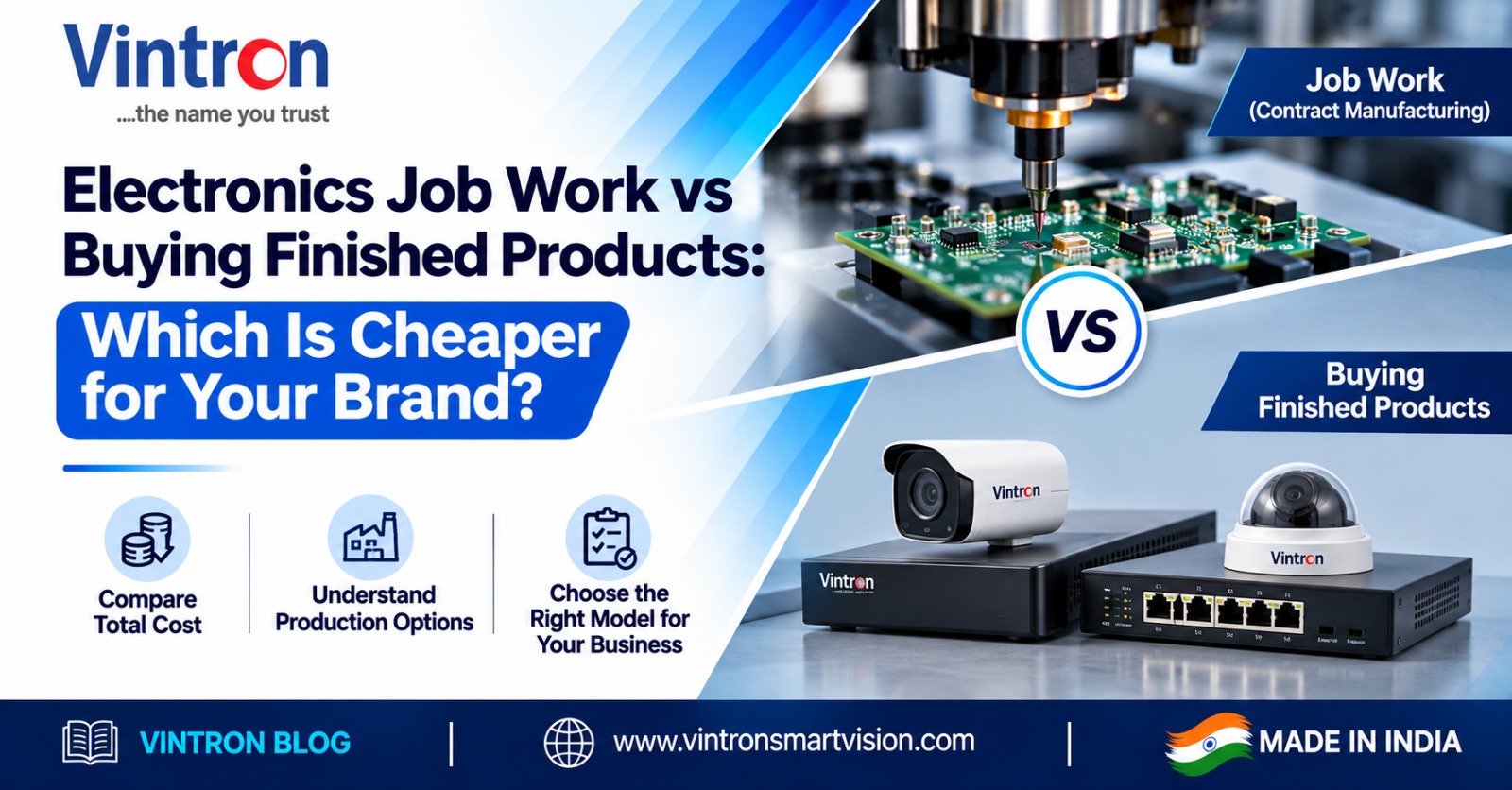
If you sell an electronic product under your own brand, sooner or later you face the same question. Do you buy the finished product from a manufacturer, or do you hand a manufacturer your own design and have it built for you? The second route is called job work. Many founders and product teams assume it is always cheaper, and many assume it is always harder. Neither is true. The right answer depends on your product, your volumes and how much of the work you want to own.
In electronics job work, you own the design. You give the manufacturer your circuit board files, your list of parts, your assembly instructions and your test method. The manufacturer builds the product to that specification, tests it and packs it. The product is yours, the brand is yours and the design stays yours.
Some companies call this contract manufacturing or EMS, short for electronics manufacturing services. The idea is the same. You bring the design, and the factory brings the machines, the people and the process.
Here the manufacturer already has a product, designed and tested, and you buy it in the quantities you need. You may sell it under the manufacturer's name or under your own label. You do not manage a design, parts or a production run. The trade-off is that you get the manufacturer's design, with limited room to change it.
The unit price is only one line in the cost of a product. When you compare the two routes, look at every line:
|
Cost line |
Buy finished |
Job work, 500 units |
Job work, 5,000 units |
|
Components |
Included in price |
600 |
600 |
|
Assembly and testing |
Included in price |
150 |
150 |
|
Packaging |
Included in price |
50 |
50 |
|
One-time set-up (Rs 50,000 spread over the order) |
None |
100 |
10 |
|
Cost per unit (Rs) |
1,000 |
900 |
810 |
Example only. These are round numbers to show how the lines add up. They are not Vintron prices, and real component prices also change with the quantity you buy.
The lesson is not the final number. It is the shape. At 500 units the set-up cost is a large part of each unit, so job work saves little. At 5,000 units the same set-up almost disappears, and the gap grows. On top of the table, job work also asks you to put money into parts early and to manage the process. Add those to your sums before you decide.
1. How sure are you of your volumes for the next 12 months? Uncertain volumes favour buying finished.
2. Is the design really yours, or are you reselling a standard product? A standard product points to buying finished.
3. Do you have a person who can manage parts, drawings and quality? If not, plan for support from the manufacturer.
4. How much cash can you put into parts and set-up before the first sale?
5. How important is it that you can change the product on your own schedule? If very, job work gives more room.
If most of your answers lean one way, you have your direction. If they are mixed, start with a pilot order and learn from it before you commit to a large run.
|
Myth |
Fact |
|
Job work is always cheaper. |
It is cheaper only when the volume is high enough to spread the set-up, and when you count the parts, stock and management time. |
|
Job work means giving up control. |
It gives you more control, because the design, the test method and the change history are yours. |
|
Buying finished means no risk. |
You depend on the manufacturer's design and supply. Ask about continuity and support before you commit. |
|
You must pick one route forever. |
Many brands begin by buying finished and move part of the range to job work as volumes grow. |
Vintron has been manufacturing in India since 1991. Our facility at A-37, Sector 58, Noida has 10 fully automatic SMT machines and more than 200 qualified engineers, and it builds our own cameras, recorders, PoE switches and power supplies every day. You can read more on our EMS profile and manufacturing facility pages. A team that builds products daily can tell you quickly whether your design is ready for production.
How many units do I need for job work to make sense?
It depends on your product, its parts and how much set-up it needs. We would rather look at your design than give you a number that may not suit you. Call us and share what you are building, and we will give you an honest view.
Can I give you my own design?
Yes, that is the starting point for job work. Share your board files, parts list and test method, and we will tell you what is needed and what we can do.
Will my design stay confidential?
Discuss this at the start. We are happy to talk about how your files and information are handled before you share anything.
How long does a first build take?
It depends on the product and on how quickly the parts can be sourced. We can give you a realistic plan once we see the design.
Job work can be the cheaper and better route, but only when the product, the volume and your team are ready for it. Compare the full cost, be honest about how much work you want to own, and speak to a manufacturer before you decide. In the next episode, we look at one of the first choices you will face: turnkey or consigned.
To talk about your product, call our toll-free number 1800-121-4322 or write to lead@vintronsmartvision.com. You can also see our facility and range at www.vintronsmartvision.com.
Vintron Smartvision Pvt. Ltd.
A-37, Sector 58, Noida 201301
Toll free: 1800-121-4322 | lead@vintronsmartvision.com | www.vintronsmartvision.com